de Kooning and me
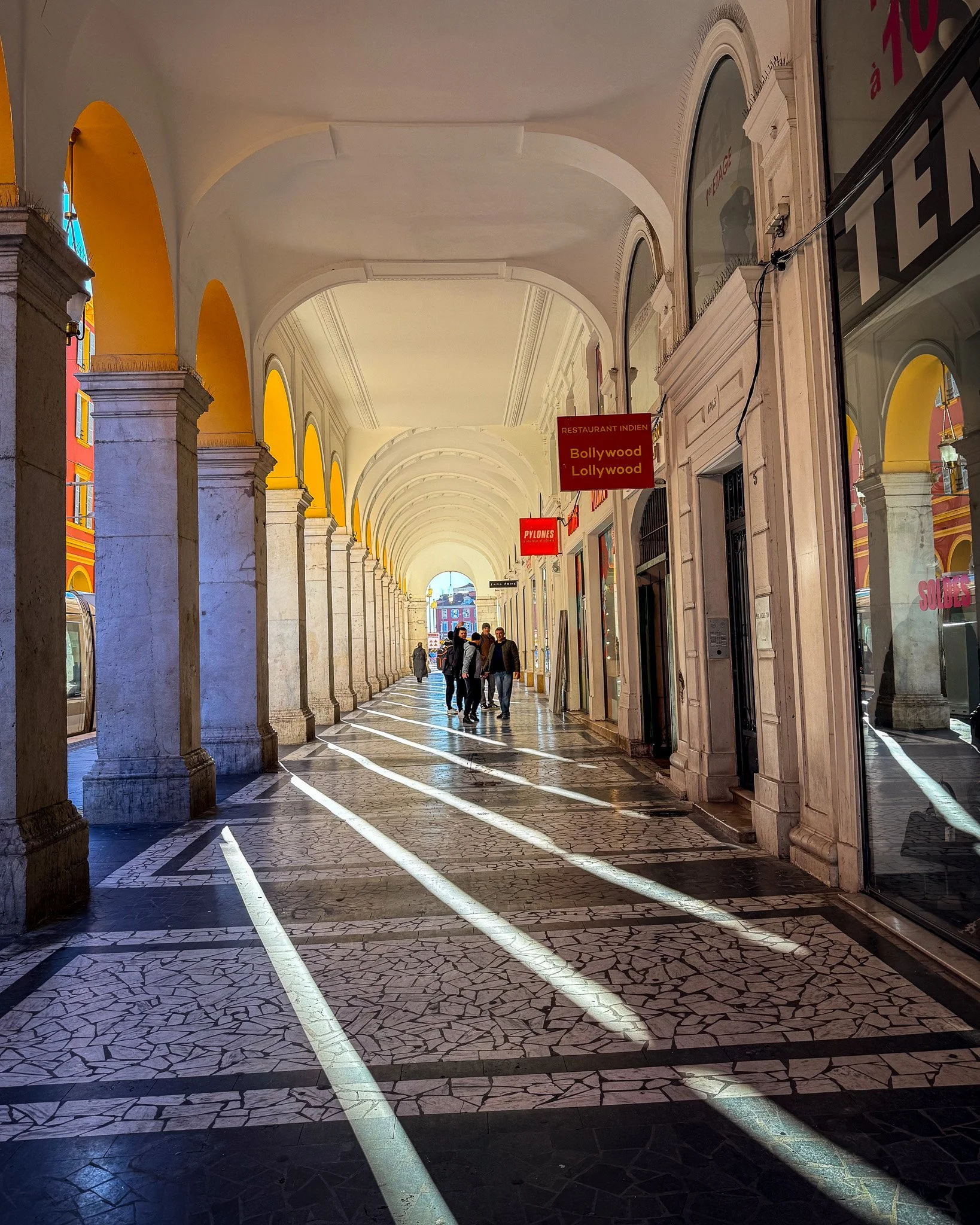
Place Massena in Nice
I have barely left the apartment this week. It’s rainy and, believe it or not, Nice actually does get cold in the winter. Staying inside and eating comfort food is just nicer. For what is ostensibly a travel blog, this makes for paltry topics. I’m sure you’d be enthralled by reading about what I cooked. Nevertheless, I feel like writing and I want to get back to a more regular cadence with these posts. What that means for this week is a more cerebral set of words.
Oh, you’re still here? Great.
I was thinking this week about time, as I often do, and specifically how it works, and doesn’t, like you think it might. I’m reading a biography about the mid-century artist Willem de Kooning. (de Kooning: An American Master by Mark Stevens and Annalyn Swan, winner of the 2005 Pulitizer Prize and National Book Critics Award Circle Award. It really is excellent.) The book seems to cover every second of de Kooning’s life and while I haven’t quite finished the 650 pages yet, I’ve reached his age, 60, in the book, which is my age now, and I find a lot about de Kooning’s life that I can relate to.
I think, like a lot of creative people, that we can can be incredibly selfish. de Kooning certainly was and I feel I have been, too. He put his art-making before all else; before his family, his relationships, and even before his health and well-being. He only had one child, and that didn’t happen until he was well into his 50s and it was definitely not a planned pregnancy. I’ve never had children and while the idea of having children has has ebbed and flowed in my life, and I have been accused of “having the makings of a good father,” I could never get comfortable with the idea of what the sacrifices would have been.
Also, like de Kooning, I’ve moved so regularly, that it would appear that I am quite unstable. I don’t disagree with anyone who might come to this conclusion. de Kooning moved as a form of reinvention, a way to find new beginnings, a psychological wiping of the slate. Oh, do I understand this—deeply. Ironically, he never moved more than a few blocks from loft to loft in lower Manhattan once he jumped ship in America as a young stowaway in his twenties when he left his homeland in The Netherlands. I was happy to go from coast to coast and back, and now I am in France. I can clearly see in the book that over the decades he never escapes from himself, though not for lack of trying. His past was dynamically locked into his current being, and while the idea of jettisoning one’s past is understandable, it is impossible. It certainly didn’t stop him, nor me, from trying it, though.
He was perpetually trying to find what all artist’s are seeking: validation. That’s a word fraught with layers of meaning. Each time he moved to a new space, or to a new woman, he hoped it would be the time that hit and he would get famous. He wanted market recognition, as did I. He ultimately found it, but I did not. He wanted validation on his own terms, by his own definition. Same for me. I did have starts and stops of market validation early in my career, but ultimately not what I hoped for. When he was younger he would regularly destroy works of art as not good enough in fits of self-doubt. I have stood over containers at the dump and thrown finished canvases into the pit, I have torn silver prints into pieces and tossed the remnants. I have known that feeling of deep disappointment in your work. And I have looked back at scans of some of those works decades later and thought, “Oh no, they were actually pretty good.” The psychology of self-validation is tough to endure which is why artists crave market validation to hold onto. If others tell you that you might be good enough, you might actually not be the imposter you know you are. When you don’t get it, it’s hard to keep believing in yourself. The money from being recognized doesn’t hurt either.
There were times in de Kooning’s life when he was so poor that he was eating only at other people’s houses, otherwise surviving off of bread and nickel beer. Eating only every couple of days. There have been times in my life when I made $14,000 per year and was in debt up to my eyes, but you know me, I never missed a meal. He made a decision at about age 35 to forego any commercial work and to dedicate his complete being to fine art. He was willing to pay that price and he had enough belief in his work to suffer the consequences. And suffer he did. I remember being 35, and divorced, living back in California after a decade on the east coast. I was crawling around every night doing long exposure night photography, almost arrested twice for trespassing, and being so lonely, broke, and depressed. I was making really good art then (I can say that now) and living the artist’s life all right. de Kooning endured another fifteen years of that life, falling deeper into despair and alcoholism, finding and then usually promptly destroying new relationships with different women, while remaining relatively unknown to the art world. I just couldn’t do it. Whether I had the actual talent our not, it didn’t matter, I didn’t have the faith.
Here is where the similarities between de Kooning and me stop, obviously. I can’t compare with his success as an artist, few of us can. Instead, I found new beginnings by abandoning that life. I found that I was a good art director, and I found Deloitte, and a commercial purpose. It wasn’t fine art, but it was creative and in it I found personal validation and a new source of self-respect as I began to see my value through the eyes of my colleagues. This, no-doubt, also opened me spiritually and made me open to meeting Chien-hui when she came into my life. I had traded one unstable, undiscovered artist’s life for a different one of unexpected recognition and stability. Yes, I still moved incessantly, but I was lucky enough to find both a person and a company that tolerated it all.
In 1950, de Kooning suddenly caught like wildfire. After 30 years of obscurity, he became the anointed king of the “new” American art of Abstract Expressionism (especially after Jackson Pollock, the previously anointed king, killed himself and an unfortunate young woman, Edith Metzger, in a drunken car crash). de Kooning suddenly had money, notoriety, museum shows, more market validation than he could have ever dreamed of. And he was miserable. He was so much more comfortable raging against the machine than suddenly being the face of it.
While I don’t know what it is like to be that successfully miserable, what I can relate to is the idea that things are often very different from what we envision. When I was in my twenties and I imagined my life at 60, I thought I would be a successful commercial photographer. That didn’t happen, but I never stopped making pictures. I did dream of living in France, like one might dream of becoming famous, but I wouldn’t have thought it was really possible or likely. But now that I am here, it doesn’t at all feel like I imagined it. And, I dreamed of traveling, slowing time down and experiencing how others live and see the world, and somehow I am doing that. The point is you may not even recognize your own success until you look back on it. I think this is universal, no? It all just feels so normal when you’re living it. The “specialness” that one projects onto their perceived future selves is illusory, especially for creative people. Only others can project that onto you, and chances are when they do, it won’t be very comfortable. It wasn’t for de Kooning, or David Bowie, or Rembrandt, and the list goes on. Imposters syndrome is very real. Sometimes it’s even deadly. I’m specifically thinking of Cobain, Bourdain, and David Foster Wallace.
So, here I find myself at age 60 thinking again of market validation. Only this time, my definition of the market is a lot smaller, and much more realistic, and healthy. Now it consists of mostly people I know or have known in my life. People who know me and have supported me in one way or another. This new photography book that I have created, Let’s Been There, which is at the printer right now, and will be ready to release in early April, was intended for all of you, my private audience. I’m really proud of it and I am very excited to share it.
In fact, I’ve already begun the next one, which will be a collection of black and white images going back to 1986, a 40 year retrospective. It’s just crazy what time does to perception. I have made images every week since I was a teenager, I always have, and now I find I have accumulated a lifetime’s worth of work. Recently, I have been looking back at them, deeply, and proudly, I find myself thinking, hey, these are actually really good. Some of them are old enough to feel like they are somebody else’s photographs, but nope, they’re mine. Maybe next year sometime for this book, I’ll keep you posted.
Finally, I wanted to update you on the wine journey. I finally heard back on my test results from the October test in London: Pass with merit. What a freaking relief. I am still waiting on the results from this recent test in January, and I should get those results in early March. Again, I’ll keep you posted. Four down, two to go to earn the WSET Diploma.
I appreciate you reading this far. I have travel trips to Tuscany, Italy, coming later this month, then Barcelona in March, Bordeaux in April, England in June, and The Netherlands in July, so I’ll be back to regularly scheduled programming soon enough. If you haven’t subscribed to this blog, please do so below. Also, my Instagram for Let’s Been There (@letsbeenthere) is updated with travel images daily. Follow me there.